Visit the Shop at LiturgicalTime.net:

Showing posts with label Epiphany. Show all posts

Saturday, January 5, 2013

Happy Epiphany! - Chalking the Door

By J.-H. Janßen (Own work) [CC0], via Wikimedia Commons
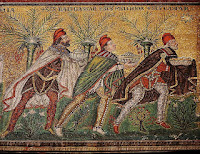
Happy Epiphany!  Today the 12 days of Christmas draw to a close, and we celebrate the proclamation of our Savior Jesus Christ to the world. The three Magi will kneel before the Christ Child tonight, representing the all corners of the world. He is the Savior for all people.

The Epiphany is traditionally a time for the blessings of homes accompanied by holy water, incense, and prayer. The chalking of doors is a significant part of this tradition. Harkening back to the Israelites' marking of their doors with blood so that their homes would be passed over, this practice involves the marking of the doors of Christians to invite the presence and blessing of Our Lord.

A priest may preside over this liturgy, but it is not necessary. The father, or head, of the household may do so. In some families, the person who found the bean or baby in the king cake has the honor of doing so.

Various elements go into the sacred markings placed above the door.  The marking for this year is:
20 + C + M + B+ 13

The meanings are:
20 = First digits of 2013
C = Caspar
M = Melchior
B = Balthazar
13 = Last digits of 2013

Caspar, Melchior, and Balthazar are names of the three Magi handed down from ancient tradition. An alternative meaning for "C + M + B" is Christus Mansionum Benedicat ~ May Christ Bless This Dwelling.

By Nina-no (Own work) [CC-BY-SA-2.5
 (http://creativecommons.org/licenses/by-sa/2.5)], via Wikimedia Commons

Chalking is done with garden variety chalk board chalk or sidewalk chalk. The markings will gradually fade, and will completely gone by next Epiphany.  They will serve as a reminder to all who pass under them, that the home being entered is dedicated to, and blessed by, Our Lord.

A Liturgy for the Chalking of Your Door
from Paul Bosch & André Lavergne via the Lift Up Your Hearts web site
    On the Epiphany of Our Lord, January 6, family and friends (C for "community") gather at the main entrances to homes or apartments (nursing home quarters, extended care facility, hospital rooms!), and ask God's blessing on their dwellings and on all who live or visit there.
    Leadership may be shared with a change of voice at each Leader's part (L).
    L     Peace be to this house and to all who enter here.
    L     A reading from Proverbs: "By wisdom a house is built, and through understanding it is established; through knowledge its rooms are filled with rare and beautiful treasures."
    L     Let us pray: Gracious God, as a shining star once guided the magi to the birthplace of the infant Jesus, so enable those who dwell here to be your light in the world; through Jesus Christ we pray.
    C     Amen.
    Using chalk (hence, "Chalking the Door"), people are invited to inscribe the lintel of the home (the horizontal frame above the door) with the inscription shown below. The letters C M B come from the traditional (9th century) names for the "three kings" -- Caspar, Melchior & Balthazar. Some also suggest "Christus Mansionem Benedicat" which means "May Christ bless this dwelling!"
    Each person is afforded a turn to make one or more of the marks:

    20 + C + M + B + 13

    L     A reading from Isaiah: "The effect of righteousness is peace, and the result of righteousness, quietness and trust forever. My people will abide in a peaceful habitation, in secure dwellings, and quiet places."
    People may join hands or extend their hands outward and upward (orans) for the prayers.
    L     Let us pray: Sovereign God, we pray that you will bless this home and all who live here with your gracious presence, that your love may be our inspiration, your wisdom our guide, your truth our light, and your peace our benediction; through Jesus Christ we pray.
    C     Amen.
    L     Lord, remember your children and teach us to pray:
    C     Our Father...
    People may make the sign of the cross in remembrance of their baptism.
    L     May the Lord watch + over our going out and our coming in, from this time forth and forevermore.
    C     Amen.

+ + +


Some additional liturgies for the chalking of your door:

CatholicCulture.org
Lutheran Church of Canada
Baylor University (Scroll down to Litany of the Magi's Blessing at the end of the document.)
United Methodist Church
Ars Orandi

Pax Christi dear ones,
May Our Lord bless your homes and all who dwell in them throughout 2013,
~Michelle
You may also like:

Linked with:
Blogs on the Blog Hops page.

Thursday, February 2, 2012

Today is Candlemas...and Why It Matters

Photo: Lawrence OP, click for license
Today, Feb. 2,  is the fortieth day after Christmas.  Upon the fortieth day following birth, devout practicing Jews, like Mary and Joseph, presented themselves in the temple for the ritual purification of the new mother, and to redeem the first born son, who by rights, belonged to God. While Epiphany-tide may last a bit longer depending on the date of Easter, the Christmas season ends, completely, today.

Upon Jesus' presentation in the temple, he was encountered by two rather significant people, the aged and devout Simeon, and the very aged prophetess Ana.  They each had been waiting a long time for this.  They knew his worth, and, the world changing event which had occurred with his coming.

Simeon's song upon experiencing this meeting is well known, and is part of the evening prayers of many liturgical Christians:

"Lord, now lettest thou thy servant depart in peace, 
according to thy word;
for mine eyes have seen thy salvation
which thou hast prepared before the face of all people,
to be a light to lighten the Gentiles,
and to be the glory of thy people, Israel."
~Luke 2: 29-32

Imagine their joy, upon meeting their Lord.  It could be our song, couldn't it?  Each of us. Redeemed and overcome with peace.
PD {1923}


As the days lengthen, and the light returns, we have this day to recognize the true light among us, and rejoice.  Meditate upon his priceless worth today, and welcome him, will you?

~~~~~~~~~

Soon, Mardi Gras (Fat Tuesday) will be upon us...a last hurrah of Epiphany-tide.  The next day will be Ash Wednesday, our entry into the solemnity, introspection, re commitment, and self-renewal of Lent...which is observed in preparation for the Holiest Feast of all, the Feast of the Resurrection of our Lord.  We have much to anticipate.

Pax Christi, Friends,
~Michelle


Visit Liturgical Time on Facebook.

Linked with:


Would you enjoy the convenience of delivery of Liturgical Time directly to your email box?  Subscribe here:


Enter your email address:


Delivered by FeedBurner

Thursday, January 5, 2012

They’re Here!...and Why It Matters


Adoration of the Magi, Peter Paul Rubens, 17th Century

Happy & Blessed Epiphany!

They made it!  They have arrived. 

The three kings have reached the baby.  They have brought him gifts…
Gold (for Kingship)…Frankincense (for priesthood) … and Myrrh (for the burial of a Savior)...

They have had….an Epiphany.  They know that he is God.

This night, across the globe, Christians of a multitude of persuasions will remember the Magi, and the discovery that they made.  Some will give one another gifts, in memory of the Three Kings’ famous gifts to the Holy One.  

Others will feast, and top it off with a King cake, with a baby hidden inside for a lucky family member to discover in his or her piece of the sweet bread.

Traditional Christians embark, beginning today, upon the season of Epiphany and the God discovery that comes with it.  This leg of our journey through the Liturgical year will take us to Mardi Gras, the last day of the Epiphany season, and the gateway to Lent.

Why it matters

Sometimes, in our atmosphere of comfortable religious freedom, we forget that we are talking about God here.  We like to have warm and fussy “feel good” church services that bolster us up for the week and …dare I say it?.... entertain us with a good sermon and great music.  I have even seen churches advertise “Starbucks Coffee after the Service”.  But, it’s not about US; it’s about HIM.


The Adoration of the Magi, Rembrandt 1632
Eternal God came down, took on human flesh, and dwelt among us… “for us and for our salvation”.  Almighty God “full of grace and truth”.


It’s a heavy thing.  Do we recognize him?  Do we fully, deeply acknowledge that he is God?  Are we so overwhelmed, by the reality of it…of Him… that we hit the ground on our knees?  That is what the season of Epiphany is about.  Recognizing …really recognizing… God in Jesus. 

The Epiphany season  is a time for us to have a special focus on visiting the Babe and bringing him our gifts.  To fall down and worship him.  To see him and to know that He is God.
What a blessing…this ‘Epiphany’….this leg of our journey.  Shall we continue our travels, with our Lord, through this church season…and beyond? 

Thank you, friends, for walking with me.
Pax Christi,
~Michelle

You May Also Like:
Twelfth Night
Linked with:
Would you like the convenience of having Liturgical Time delivered to your email box?  Subscribe here:
Enter your email address:


Delivered by FeedBurner

Wednesday, January 4, 2012

Twelfth Night

Have the wise men from your nativity set been traveling gradually through the rooms of your home, steadily approaching the location of the Christ Child?  If so, today they must be very close, because technically, Epiphany begins January 5, Twelfth Night, at sundown.  The shepherds of course, have been packed cozily in their box for a few days now.  Their time in the Christmas story has passed.

 Viewed literally, it may have taken the wise men up to a couple of years to reach Jesus.  They actually met him in a house, not the stable.  But, literalness aside, our wise men are in the same room as Jesus now, and will arrive on Epiphany, January 6, to worship him as he rests in his manger.

Twelfth night is two things:  The last day of Christmas and the start of Epiphany.  It is double cause to celebrate.  Of course Shakespeare made it famous with his play of the same name, but for the most part, Americans likely do not even know what Twelfth Night is...particularly with the secular compulsion to celebrate "Christmas" during Advent, and to pack the whole jubilee up the next day.  But, we walk the seasons here, and stubbornly so.

In Colonial America, edibles such as fruits were removed from Christmas decorations on the Twelfth Day of Christmas, and eaten.  The decorations, of course, were then packed away, for on this day, we say a festive goodbye to the Christmas season, and a warm hello to Epiphany.

Wassail and King Cake are often on the menu on this night.  In some families, the King Cake is baked on Twelfth Night and eaten on Epiphany.  As is evident from Shakespeare's play, Twelfth Night celebrations could get pretty raucous in Medieval times.  Our family is not quite so rowdy, but nonetheless, we are exiting the Christmas feast and entering into the last hurrah (the Epiphany season) before the contemplative period of Lent.  I believe that keeping the observances of  the church year guides us toward immersing ourselves in all aspects of the gospel and Christian living, rather than allowing us to simply focus on the ones that feel good or are easily entered into.

So then, tonight, with our eye on the star, we feast!

Revel heartily friends!
Blessings,
~Michelle


You may also Like:


Linked with: 
Would you like the convenience of having Liturgical Time delivered to your email box daily?  Subscribe here:
Enter your email address:


Delivered by FeedBurner